A Line Between Cairo and the Indy 500 No One Saw Coming
I’ve discovered a first for the Indianapolis 500.
In 1993, Egypt’s first skater, Mo Kamel, wrote a letter to Santa Cruz Skateboards asking if they would consider sending decks to him so he could share them with kids in Cairo.
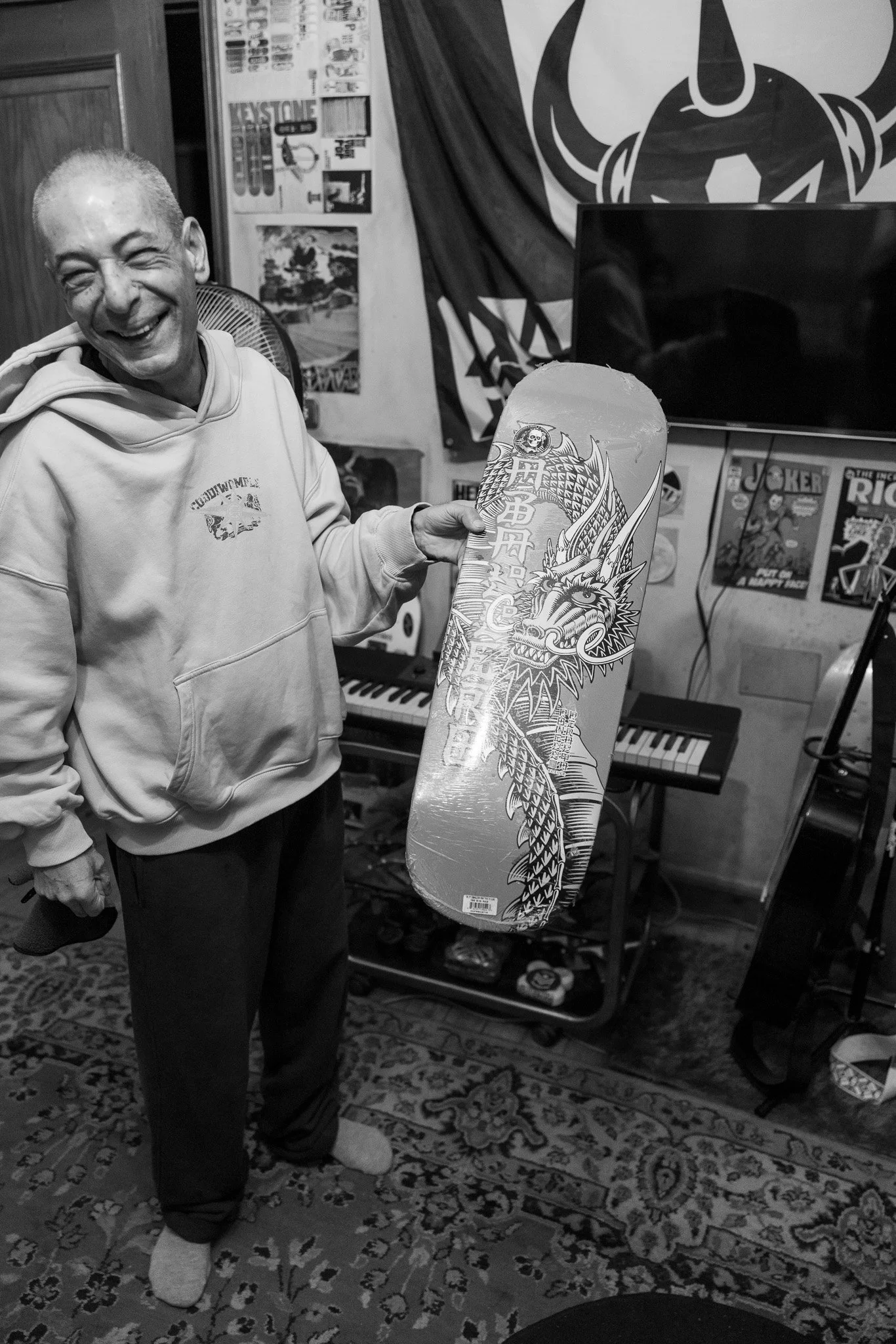
Mo Kamel in his Cairo Apartment, holding one of his prized skatebaords.
Thirty‑three years later, one of those decks resurfaced for the first time online — and it’s connected to one of the wildest moments in Indy 500 history.
In early 2026, I was in Cairo working on Cairo Underground, a long‑form project documenting skateboarders, metal bands, and tattoo artists. I wanted to understand what it feels like to live inside a conservative culture while being pulled toward the parts of counterculture that sit outside the accepted frame. The trip shifted how I see the world. It also clarified something about my own process — how much of my work depends on being surprised.
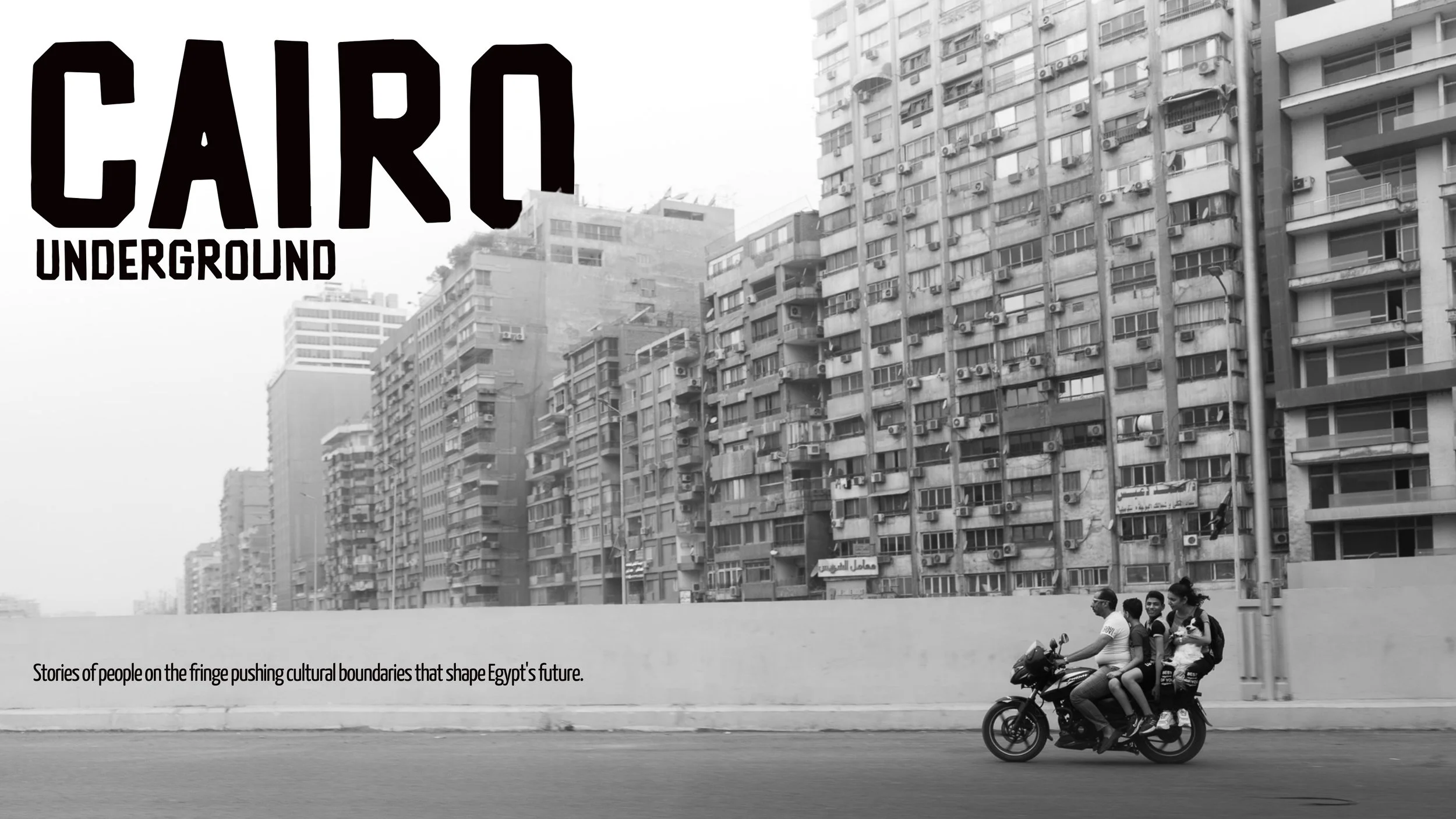
Family Life in Egypt. 4 people and one dog on a motorcycle passing the vast urban landscape of Cairo.
One of the first people I met was Yehia Ossama, painter, teacher, and one of Cairo’s earliest skaters. He helps run Amulet Skateshop, one of only a handful of places in Egypt where you can buy a skateboard. Yehia talked about the realities of skating in Cairo — the cost, the scarcity, the cultural friction — and then pointed me toward his partner, Hani Talat, who handles the day‑to‑day of keeping the shop alive.
Hani is in his mid‑30s, a new father, and one of the strongest cinematographers in the region. He’s been documenting Cairo’s skate scene since 2008. We talked about the economics of running a shop in a volatile currency, the challenge of building a community before a market exists, and the simple fact that for most Egyptians, a skateboard is still out of reach.
Then he brought out the deck.
Our interview was in early May — just a few weeks before the Indy 500. After a short break, Hani came back holding a board he hadn’t looked at in years. I asked about the graphic.
He said: “It’s an Indy car on fire.”
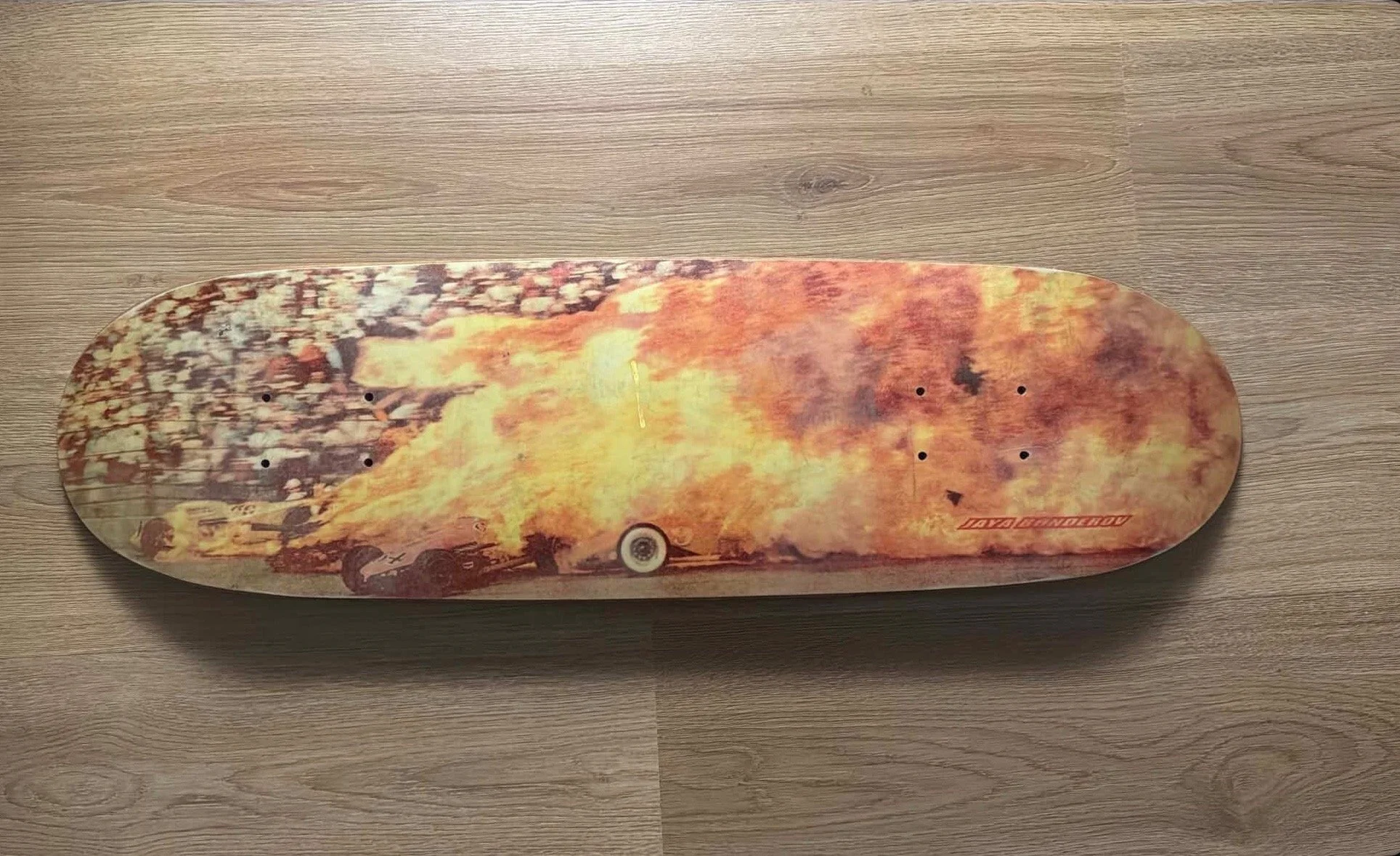
The Santa Cruz Jaya Bonderov Deck owned by Hani Talat of Amulet Skateboards in Cairo Egypt.
The deck was a Santa Cruz Jaya Bonderov slick, produced between 1990 and 1993. The graphic is pulled from one of the most infamous moments in Indy 500 history.
The Crash: Indy 500, 1964
Lap 2. Turn 4.
Driver Dave MacDonald lost control of his car, hit the inside wall, and slid back into traffic. Driver Eddie Sachs struck MacDonald’s car at full speed. Both cars exploded into a massive fireball.
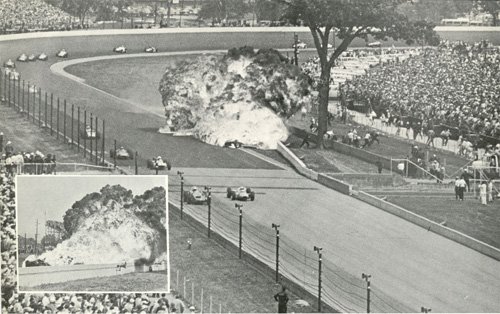
The smoke was so thick that the remaining drivers had seconds — maybe less — to decide whether to stop and risk being hit from behind, or drive blind into a wall of fire and hope there was a path through.
Some slowed.
Some swerved.
Some accelerated, gambling that momentum might carry them through whatever was inside that smoke.
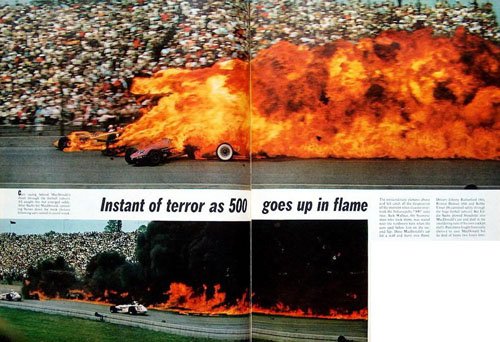
The spread from Time/Life Magazine in 1964 recapping the race showing the massive size of the fireball from the crash.
It was one of the deadliest moments in Indy 500 history, and the race was red‑flagged for the first time due to a crash.
And that’s the image printed on the deck Hani has been sitting on for nearly twenty years.
A board sent to Cairo in the early 1990s — part of a small shipment sparked by a letter from Egypt’s first skater — ended up in the hands of a Cairo cinematographer in 2008. And the graphic on that board? A moment burned into Indycar and Speedway history.
Indianapolis already has its strange architectural nods to Egypt — the pyramids on the north side, the Egyptian Room at the Murat, the Circle Tower entryway, the Butler Lab’s Egyptian motifs.
Now it has something else:
A story of a skateboard in Cairo carrying one of the Indy 500’s most haunting images
